Private vs Serviced Office vs Coworking | London Guide
VenCome Team
14 October 2026
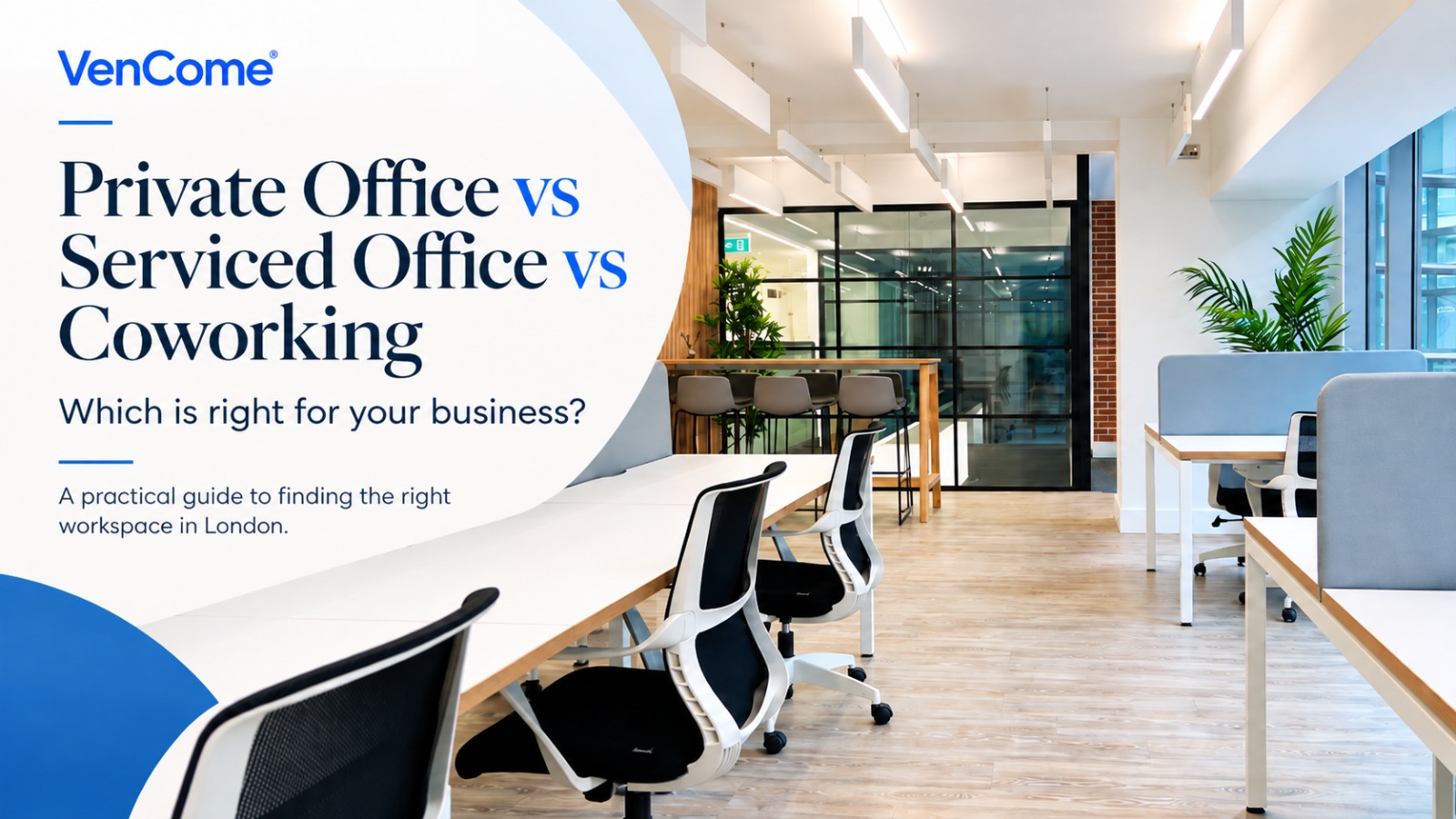
Choosing an office is not simply a choice between working from home and signing a long commercial lease. London businesses can now choose from private offices, serviced offices and coworking spaces, with different levels of privacy, support and commitment.
The terminology can be confusing because these categories sometimes overlap. A private office describes a space used exclusively by one person or team. A serviced office describes how the space is furnished and managed. This means a private office can also be a serviced office.
The right option depends on how your business actually works: how many people need the space, how often they will use it, whether conversations must remain confidential and how predictable your demand will be over the coming months.
The quick answer
- Choose a private office if you need a consistent, lockable space for focused work, confidential calls or a small team.
- Choose a serviced office if you want a private, ready-to-use office with facilities and day-to-day management included, subject to the individual agreement.
- Choose coworking if you mainly need a desk, value a shared environment and want to keep your commitment light.
Private office vs serviced office vs coworking at a glance
| Factor | Private office | Serviced office | Coworking |
|---|---|---|---|
| Space | Dedicated room or suite | Usually a dedicated, furnished room or suite | Shared workspace, hot desk or dedicated desk |
| Privacy | High | High within the office; wider facilities may be shared | Lower in open areas |
| Setup | Depends on the listing | Usually ready to use | Usually ready to use |
| Facilities | Vary by property | Often bundled or managed | Shared facilities are normally available |
| Commitment | Can be flexible or long term | Commonly flexible, but terms vary | Often day passes or memberships |
| Best for | Individuals and teams needing consistency | Businesses wanting privacy with less operational work | Freelancers, remote workers and occasional users |
| Main point to check | What is included in the price? | Which services and meeting-room access are included? | Will noise, privacy and desk availability suit your work? |
What is a private office?
A private office is a room or suite reserved for one person, one business or one team. It gives you a door you can close and a consistent base for equipment, documents and daily work.
Importantly, private office does not automatically mean a traditional long-term lease. A private office may be offered through a flexible monthly agreement, as part of a serviced building or under a longer commercial lease. “Private” describes who uses the space, not necessarily how long they must rent it.
A private office can work well when:
- you regularly handle confidential calls or sensitive information;
- your team needs quiet, reliable working space;
- clients visit you and a shared desk would feel unsuitable;
- you want a consistent location without sharing your immediate work area; or
- you need to leave equipment or materials securely between visits.
The trade-off is that privacy can cost more than a shared desk. You should also check whether furniture, internet, cleaning, utilities, business rates, service charges and meeting rooms are included.
What is a serviced office?
A serviced office is a workspace managed by an operator and normally prepared for a business to move into quickly. It is often furnished and may include internet, cleaning, reception support, utilities and access to shared kitchens or meeting rooms.
This can reduce the time and upfront spending involved in setting up an office. Instead of arranging furniture, broadband and several suppliers separately, the business pays for a workspace with some or all of those services already organised.
Serviced offices are particularly useful for businesses whose demand is not yet stable. A company may know that it needs professional space now without knowing exactly how many desks it will require in six or twelve months. A more flexible agreement can reduce the financial risk of paying for unused capacity.
However, “serviced” does not guarantee that every cost is included. Meeting-room hours, printing, parking, storage, VAT and out-of-hours access may be charged separately. Always compare the full monthly cost and the services provided, not only the headline price.
What is coworking?
Coworking gives individuals and teams access to a shared working environment. Depending on the provider, this may include hot desks, dedicated desks, phone booths, meeting rooms and communal areas.
It can be a practical choice for freelancers, remote workers, founders testing a new location or businesses that only need workspace on selected days. It also offers more opportunities to meet people from other companies than a fully private office.
The main compromises are privacy, noise and consistency. A hot desk may not be in the same position each day, and meeting rooms or private booths may need to be reserved separately. Coworking may therefore be less suitable if most of your day involves confidential conversations or uninterrupted concentration.
The real cost question: what will you actually use?
The biggest risk for a new or growing business is not simply the length of an agreement. It is taking on a level of monthly cost that assumes demand, revenue or team size will remain stable.
A low headline rent can become expensive if the business must also pay for:
- furniture and fit-out;
- internet and utilities;
- cleaning and maintenance;
- business rates and service charges;
- insurance and professional fees;
- deposits; and
- space that remains unused for part of the week or month.
Serviced and coworking options may carry a higher price per desk, but they can reduce setup costs and make monthly spending more predictable. A private office may deliver better value when privacy and regular use matter more than access to communal facilities.
The correct comparison is therefore not “Which option has the lowest advertised price?” It is “Which option gives us the space we will genuinely use at a total cost we can support?”
Current office examples on VenCome
VenCome’s current office inventory shows how widely requirements and prices can vary.
In Borehamwood, current monthly options include:
- a single-person office from £424 per month;
- a private two-desk office from £660 per month;
- a larger 9.9 sqm two-desk office from £880 per month; and
- four-person options currently listed between £1,080 and £1,144 per month.
North Finchley listings currently range from approximately £720 to £1,760 per month, while larger Central London spaces include a Holborn office at £25,000 per month and a serviced Liverpool Street floor for 20–60 desks at £28,000 per month.
These examples are not directly interchangeable. Location, floor area, capacity, fit-out, services and access all affect price. They demonstrate why businesses need to compare the details behind the monthly figure rather than treating every office listing as the same product.
Prices and availability checked on 14 October 2026. Confirm the current price, availability, VAT, deposit, inclusions and terms on the individual listing before making a decision.
Which workspace is right for your business?
Choose coworking if:
- you are a freelancer or remote worker;
- you need a desk occasionally rather than every working day;
- networking and shared amenities matter to you; and
- you do not require continuous privacy.
Choose a private office if:
- you need a quiet, lockable room;
- you have confidential calls, records or client work;
- you want a consistent base for one person or a small team; and
- the listing’s price and inclusions suit your expected use.
Choose a serviced office if:
- you want private space that is already furnished and operational;
- you prefer one managed arrangement to organising multiple suppliers;
- your team may grow or change; and
- flexibility is worth more to you than maximum control over the building.
For larger teams with stable long-term requirements, a managed or conventional leased office may eventually offer more control. That decision should account for fit-out, operating responsibilities and exit terms as well as rent.
Five questions to ask before booking an office
- How many people will use the space on a normal day? Do not base the decision only on your maximum possible headcount.
- What is included in the price? Confirm furniture, internet, utilities, cleaning, rates, service charges, meeting rooms and VAT.
- How much privacy do you need? Consider calls, client meetings, data and focused work.
- How stable is your demand? Choose a commitment that still works if your team or revenue changes.
- What access do you need? Check opening hours, security, parking, transport and out-of-hours arrangements.
Find and compare offices through VenCome
VenCome brings different types of professional space into one marketplace, helping individuals and businesses compare options by location, price, capacity and intended use.
Depending on the listing, spaces may be available by the hour, day or month. You can review the listing details, consider the terms and submit a request through the platform, with the host confirming availability.
Browse current office spaces on VenCome and choose a workspace that fits the way your business operates now—not only the business you hope it may become.
Frequently asked questions
Is a serviced office the same as a private office?
Not exactly. A private office describes a room or suite used exclusively by one person or team. A serviced office describes a managed workspace model. Many serviced offices are private offices, but a private office is not always serviced.
Is coworking cheaper than a private office?
Coworking often has a lower entry price because you are buying access to shared space rather than exclusive use of a room. The best value depends on how often you attend, whether meeting rooms cost extra and how much privacy you need.
Are serviced offices suitable for small businesses?
Yes. They can suit small businesses that want a professional, ready-to-use workspace without arranging furniture, utilities and building services separately. Check the minimum term and all included services before committing.
Can I rent office space for a day or a month?
Yes, some flexible workspaces are available for short periods, while others require a monthly or longer agreement. Availability and booking duration depend on the individual listing.
What should I compare besides the monthly price?
Compare capacity, floor area, furniture, meeting-room access, internet, utilities, cleaning, business rates, service charges, VAT, deposits, cancellation terms, opening hours and transport links.
Find your perfect commercial space
Browse offices, studios, meeting rooms and more across the UK.
Browse Spaces